

Now Reading: Defying Insights from Exit Polls on India’s Future
-
01
Defying Insights from Exit Polls on India’s Future

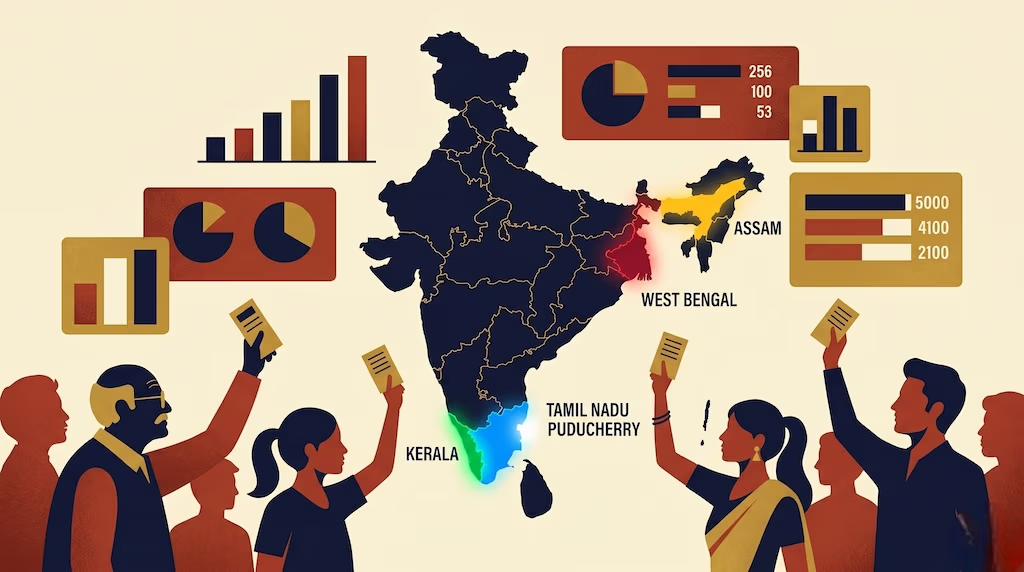
From Bengal’s seismic BJP surge to Tamil Nadu’s cinematic third front, and Kerala’s quiet anti-incumbency wave — the 2026 exit polls reveal an India rewriting its own political playbook.
The ballot boxes are sealed. The ink on 200 million fingers has dried. And India — in its sprawling, contradictory, magnificent plurality — now waits for May 4 to render its judgment. Five states and a Union Territory have voted, and the exit polls released Wednesday evening by Axis My India, Matrize, People’s Pulse, People’s Insight, and P-Marq paint a portrait of a republic in genuine flux: an electorate increasingly guided not by bloc loyalty but by lived experience, generational aspiration, and the impatient arithmetic of a young, educated, and economically frustrated citizenry.
What these numbers collectively reveal is something more than a simple swing left or right. They reveal the contours of a new Indian voter — one who grew up with smartphones before ballot papers, who measures governments not by ideology but by internet speed and job offers, and who is perfectly willing to reach for an untested celebrity politician if the traditional alternatives have outstayed their welcome. The results due on May 4 will determine whether the pollsters — and this new voter — have redrawn India’s political map for a generation.
The God’s Own Country Gamble: UDF’s Return From the Wilderness
For a decade, Kerala has confounded political scientists. When the Left Democratic Front (LDF) — led by the indefatigable Pinarayi Vijayan — defied the state’s five-decade habit of alternating power between blocs and won a second consecutive term in 2021, many declared the Kerala political pendulum permanently stilled. The 2026 exit polls suggest that pendulum has swung decisively back.
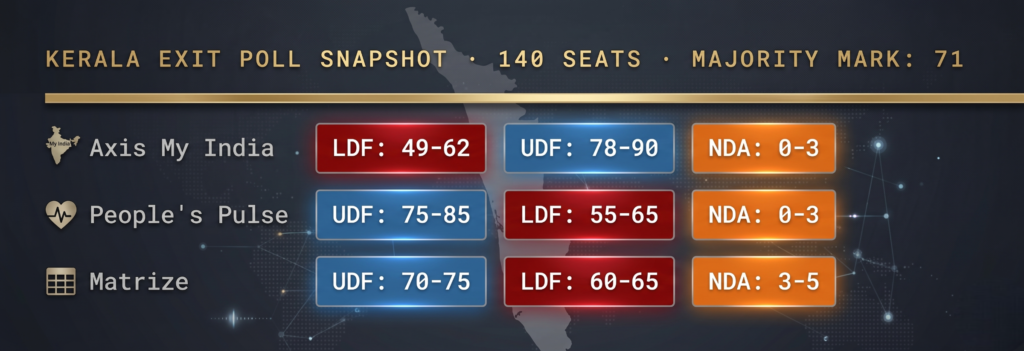
Every credible pollster places the Congress-led United Democratic Front above the 71-seat majority mark. The gap ranges from narrow (Matrize) to emphatic (Axis My India), but the directional consensus is unmistakable. The LDF, which won 99 of 140 seats in 2021, is projected to fall to between 49 and 65 seats — a potential loss of 34 to 50 seats. That is not a correction; it is a rout.
The causes are layered. After ten years in power — an almost unprecedented tenure in Kerala — the LDF is facing what political analysts describe as structural fatigue rather than a sudden crisis. Voter surveys conducted in the lead-up to the election found that 53.7% of respondents wanted the Vijayan government voted out, even as 40.3% said it should continue. That committed LDF base is real and formidable, but it was not enough to absorb the weight of accumulated grievances.
The LDF has the main problem of a disenchanted middle class and a huge army of unemployed youth, who are angry at a government that has failed to uplift their economic condition
What makes the LDF’s predicament particularly acute is the nature of the anti-incumbency. This is not the anger of deprivation — Kerala’s welfare architecture remains among the most robust in the country. It is the frustration of aspiration unfulfilled. Thousands of Keralites returned home from the Gulf as the US-Iran tensions disrupted remittance flows, straining both household incomes and state revenue. The KIIFB-funded infrastructure ambitions outpaced fiscal capacity. An educated middle class that once admired the CPI(M)’s governance now asks a starker question: where are the jobs?
The UDF, under the steady stewardship of the Indian Union Muslim League and a consolidated Congress, has channelled this dissatisfaction effectively. Yet analysts caution that even a UDF victory will not be a landslide of the 2021 variety. Several sitting LDF MLAs retain strong local credibility. A three-cornered contest — with the BJP making selective urban inroads, particularly in Thiruvananthapuram — risks splitting the anti-incumbency vote in a handful of constituencies. The final count on May 4 could be closer than the headline numbers suggest.
The Superstar Equation: When Cinema Meets the Constituency
Tamil Nadu has always treated its politics with cinematic seriousness. The state that gave M.G. Ramachandran and Jayalalithaa to Indian political history is now contemplating the emergence of a third such figure. Actor-turned-politician Thalapathy Vijay and his Tamilaga Vettri Kazhagam (TVK) have turned what should have been a conventional DMK-versus-AIADMK contest into a three-act political drama — and the exit polls have not resolved the plot.
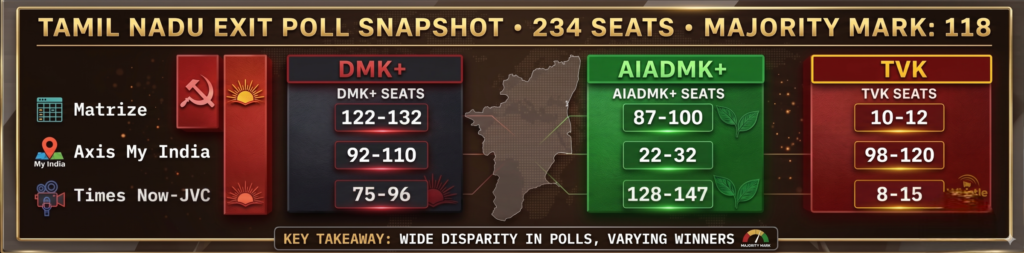
The range of projections for Tamil Nadu is extraordinary — and illuminating. Five of the major pollsters see a DMK-led Secular Progressive Alliance holding power; one (Axis My India) projects a blockbuster debut for TVK; and Times Now-JVC sees an AIADMK-led NDA winning a majority. The divergence is not careless polling — it reflects a genuine uncertainty on the ground that no exit poll methodology fully captures.
The DMK has governed Tamil Nadu since 2021, and Chief Minister M.K. Stalin has presided over a period of notable economic activity and welfare delivery. Tamil Nadu’s overall voter turnout reached 85.10%, suggesting deep democratic engagement. The AIADMK, weakened by the departure of the BJP from its earlier alliance and the internal turbulence following Jayalalithaa’s death, faces an existential contest. But it is the TVK that has rewritten the narrative entirely.
Vijay’s party has specifically and deliberately targeted a demographic that the traditional Dravidian parties have taken for granted: the young, the urban, and the restless. After the SIR exercise, nearly 40% of Tamil Nadu’s electorate is under the age of 39. TVK positioned itself as a clean alternative, anti-corruption in rhetoric and aspirational in tone. The Axis My India data — which projects TVK as the single largest force at 98–120 seats — would, if accurate, represent the most dramatic political debut in the state’s modern history. Even the more conservative projections (10–15 seats) would establish TVK as a significant third force capable of determining who governs.
Vijay could well be the next MGR. TVK is doing extraordinarily well in the Chennai region, and the youth have overwhelmingly chosen change over continuity.
What is certain is that the AIADMK-BJP combine is in crisis. Having dissolved their partnership, both parties contest somewhat independently — and the split in the traditional anti-DMK vote has benefited the ruling alliance. Even in the scenarios where DMK wins comfortably, TVK’s performance among young voters suggests that the old duopoly is over. Tamil Nadu’s political geometry has permanently changed.
Bengal’s Hour of Reckoning: Fifteen Years and a Mountain of Grievances
If there is a single result on May 4 that will reverberate beyond state boundaries and into the corridors of national power, it is West Bengal. A BJP victory in what has been Mamata Banerjee’s fortress since 2011 would be a political earthquake of the first order — and the exit polls suggest the tremors are already being felt.
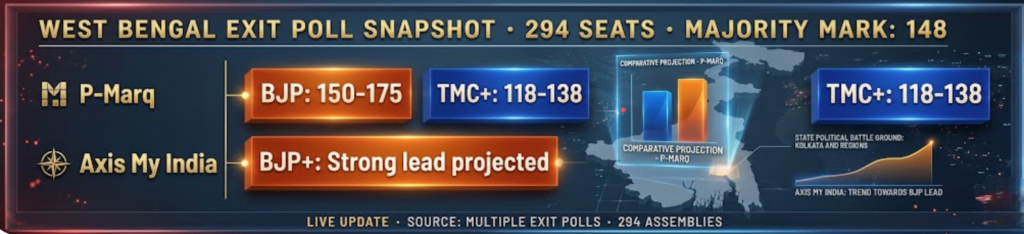
The P-Marq projection — 150 to 175 seats for BJP against 118–138 for TMC — would, if validated, end Mamata Banerjee’s reign and hand the BJP its most consequential state-level victory since Uttar Pradesh 2017. The BJP is being projected as crossing or approaching the majority mark in a state where it won just 77 seats in 2021 (up from a mere three in 2016).
The campaign that produced these numbers was among the most contentious in India’s recent electoral history. The Special Intensive Revision (SIR) of electoral rolls became its defining controversy: approximately nine million voters were removed from the West Bengal rolls, representing about 12% of the electorate. The TMC alleged disenfranchisement; the BJP insisted it was necessary housekeeping. The political charge this generated, combined with the BJP’s aggressive framing of law and order, women’s safety following the 2024 R.G. Kar Medical College incident, and the school recruitment scandal, created a potent cocktail of grievances.
After 15 years of TMC governance, anti-incumbency is no longer a political theory in Bengal — it is a lived, felt reality for millions. Corruption allegations, the perception of administrative overreach, and above all the unemployment crisis have eroded the TMC’s once-unassailable ground. The Left and Congress, historically Bengal’s dominant forces before 2011, have been reduced to marginal players; their former vote bank has migrated almost entirely to the BJP.
Employment, industrial development and public recruitment were the most prominent issues among younger and urban voters — concerns the TMC government has struggled to address convincingly.
A critical caveat must be registered here: in 2021, most exit polls predicted a tight contest that the TMC ultimately won by a massive majority — 215 of 294 seats. West Bengal has a history of polling surprises, driven by ground-level social mobilisation that surveys struggle to capture. The TMC’s booth-level organisational machinery is formidable. The question is whether 15 years of accumulated frustration — and the BJP’s dramatically improved ground operation — will finally overcome that structural advantage.
Himanta’s Hat-Trick: The Northeast’s Most Decisive Mandate
In Assam, the story is cleaner and the numbers more consistent. Chief Minister Himanta Biswa Sarma, who has transformed the BJP’s northeastern politics through a combination of aggressive governance, welfare delivery, and Hindu consolidation, appears on the verge of a historic hat-trick.
All four major agencies agree on the direction; the variance is only in the magnitude of the BJP’s victory. The BJP-led alliance is projected to cross the majority mark comfortably and potentially approach two-thirds of the 126-seat assembly. Vote share projections see the BJP alliance at 45.5% against Congress’s 39.8% — a gap that translates into an enormous seat advantage under India’s first-past-the-post system.
Assam recorded a remarkable 85.21% voter turnout, surpassing the 82.04% of 2021 — the highest of all five states and the UT. High turnout in BJP-governed states has historically benefited the incumbent, as welfare scheme beneficiaries and first-time voters who have grown up under BJP governance tend to reward continuity. The Congress, led nationally by Gaurav Gogoi in Assam’s campaign, faces the grim prospect of being reduced to a rump opposition — a political humiliation that would call into question whether any Congress-led coalition can still compete in the Northeast.
Puducherry: The Small Stage With a Large Subplot
In the Union Territory of Puducherry — 30 assembly seats, an electorate of under a million — the headline result appears straightforward. Every exit poll projects NDA victory, with Axis My India giving the alliance a commanding 40% vote share against 30% for the Congress-DMK combine and 17% for TVK. The NDA appears set to retain power in a territory it won in 2021 following years of Congress-AIADMK rule.
But the real story in Puducherry is not the NDA’s victory. It is the TVK. Vijay’s party — in its very first election, in a 30-seat territory where it has no history — has captured 17% of the vote share primarily among young voters. Exit poll demographic breakdowns show a clear generational divide: NDA’s strength increases markedly among voters aged 40 and above, while TVK leads among those under 30. This is not incidental. It is a preview of what TVK may represent across the Tamil-speaking world in elections to come.
The New Voter: Young, Impatient, and Impossible to Ignore
Across all five states and the UT, one theme emerges with unmistakable clarity from the 2026 exit poll data: the decisive entry of India’s youngest voters as an independent political force, no longer reliably delivered to any party by caste bloc, community leadership, or family tradition.
Pollsters and analysts tracking first-time and young voters (aged 18–35) note a consistent pattern: this cohort is more likely to vote on economic issues — jobs, price rise, corruption — than ideological loyalty. They are more likely to be influenced by social media than by party TV channels. And they are more willing than any previous generation to experiment with entirely new political formations.
Tamil Nadu
68% of TVK’s support base are first-time voters; 59% are in the 20–29 age bracket. Thalapathy Vijay commands 37% as preferred CM among under-35 voters, edging out incumbent Stalin (35%)
Puducherry
TVK leads among all voters under 30 in the UT, creating a sharp generational split where older voters back stability (NDA) and younger voters back change (TVK).
West Bengal
Young and urban voters drove the sharpest anti-TMC sentiment. Job scarcity, recruitment scandal, and law-and-order concerns made the 18–35 cohort the most volatile segment, with BJP capitalising heavily.
Kerala
Educated youth — including Gulf returnees — expressed the deepest frustration with LDF’s economic management. Analysts note this demographic shifted toward UDF in proportions not seen since before 2016.
Assam
High turnout among first-time voters — many of whom have grown up under BJP governance — is projected to benefit the incumbent. The BJP’s welfare reach into rural and tribal youth has created a loyal new base.
Cross-State Trend
The common thread: young voters across all states prioritise employment, inflation, and corruption over identity. Parties that campaigned on aspiration — TVK, BJP in Bengal, UDF in Kerala — have reaped the reward.
The generational shift visible in these exit polls is not merely a curiosity for political scientists. It represents a structural change in Indian democratic behaviour. For decades, the dominant theory of Indian electoral politics was that caste, community, and ideological bloc were the bedrock of vote choices. The 2026 data suggests a partial but significant erosion of this model among the electorate’s youngest members.
In Tamil Nadu, 45% of TVK supporters are in the 30–39 age group — not teenagers discovering politics, but working adults in their prime earning years who are voting their economic frustration. In Bengal, the BJP’s most striking gains are projected to come in urban constituencies where young voters who have lived through the recruitment scandal and struggled to find government jobs are voting for change with quiet determination. In Kerala, the UDF’s edge in several constituencies is attributed specifically to the swing among educated youth aged 22–35.
What is particularly notable is the role of digital media. Unlike the older generation that forms opinions through party newspapers, union meetings, and community gatherings, young Indian voters in 2026 are consuming political content on YouTube, Instagram Reels, and WhatsApp communities. This creates a volatile, fast-moving information environment where political narratives can shift overnight — and where a celebrity politician like Vijay enjoys an organic reach that no amount of traditional canvassing can replicate.
What to Watch When the Counting Begins
The counting begins at 8 AM on May 4, and official results are expected through the day. Here is what the numbers will tell us, beyond the simple horse-race of who wins:
In Kerala, watch the margin. A UDF victory of 80+ seats would validate the pollsters and signal that anti-incumbency has overpowered LDF’s organisational machinery. A closer result — say 71–76 — would suggest that Pinarayi Vijayan’s personal popularity and the welfare shield held more ground than the surveys captured. Any LDF victory would be among the most stunning upsets in Indian state-level electoral history.
In Tamil Nadu, the TVK seat count is the single most consequential variable. Under 20 seats: a respectable debut but the old duopoly essentially survives. Between 40 and 80: a transformative new third force that will reshape every subsequent election. Above 100: a political revolution, and Thalapathy Vijay becomes Tamil Nadu’s next Chief Minister. The spread between pollsters reflects genuine ground uncertainty — even respondents who voted TVK may have been reluctant to say so.
In West Bengal, early leads in the Kolkata agglomeration seats will be the most watched. If the BJP shows strong leads in South Kolkata and Jadavpur — once TMC’s urban heartland — it will signal that the exit poll projections are directionally correct. A TMC recovery in early rounds could suggest another 2021-style polling miss.
In Assam, the Congress seat count below 35 would confirm a generational political collapse for the grand old party in the Northeast. Watch the Barak Valley seats for the BJP’s expansion beyond its traditional Brahmaputra Valley base.
In Puducherry, the NDA result is relatively predictable. The number to watch is TVK’s seat haul — even three or four seats in this tiny legislature would establish it as a genuine political force ahead of future Tamil Nadu contests.
Exit polls provide the first indication, but India has a long history of surprising the surveys. May 4 is when the real story begins.” The Polity Review, Editorial Desk
The Larger Picture: What These Five States Tell India
Taken together, the 2026 assembly elections — and the exit poll data that precedes their results — tell a story about an India in democratic negotiation with itself. The BJP, if it wins Bengal and retains Assam, will have demonstrated a capacity to expand and sustain power that no opposition coalition has yet found a credible answer to. The Congress, trailing badly in Assam and essentially invisible in Bengal and Tamil Nadu, faces the question of whether it can be a national alternative or merely a coalition partner in states where regional forces lead.
The regional forces themselves are in transition. The TMC faces potential regime change. The DMK and AIADMK face a new challenger in their own homeland. The LDF faces the historic limits of incumbency. What emerges is a picture not of one-party dominance, but of genuine competition — fierce, messy, and alive.
And over all of it, the young voter watches. Studies, argues with parents over dinner, shares memes that are more politically sophisticated than the editorials of two decades ago, and votes — sometimes for change, sometimes for continuity, but increasingly for something that speaks to the economic reality they live every day. That voter — connected, informed, impatient, and consequential — is the decisive actor of the 2026 election cycle.
May 4 will tell us how their voice has been counted. India is listening.

Stay Informed With the Latest & Most Important News
Previous Post
Next Post







Advertisement