

Now Reading: Multiple Drone Intrusions Near The LoC: What’s Going On?
-
01
Multiple Drone Intrusions Near The LoC: What’s Going On?

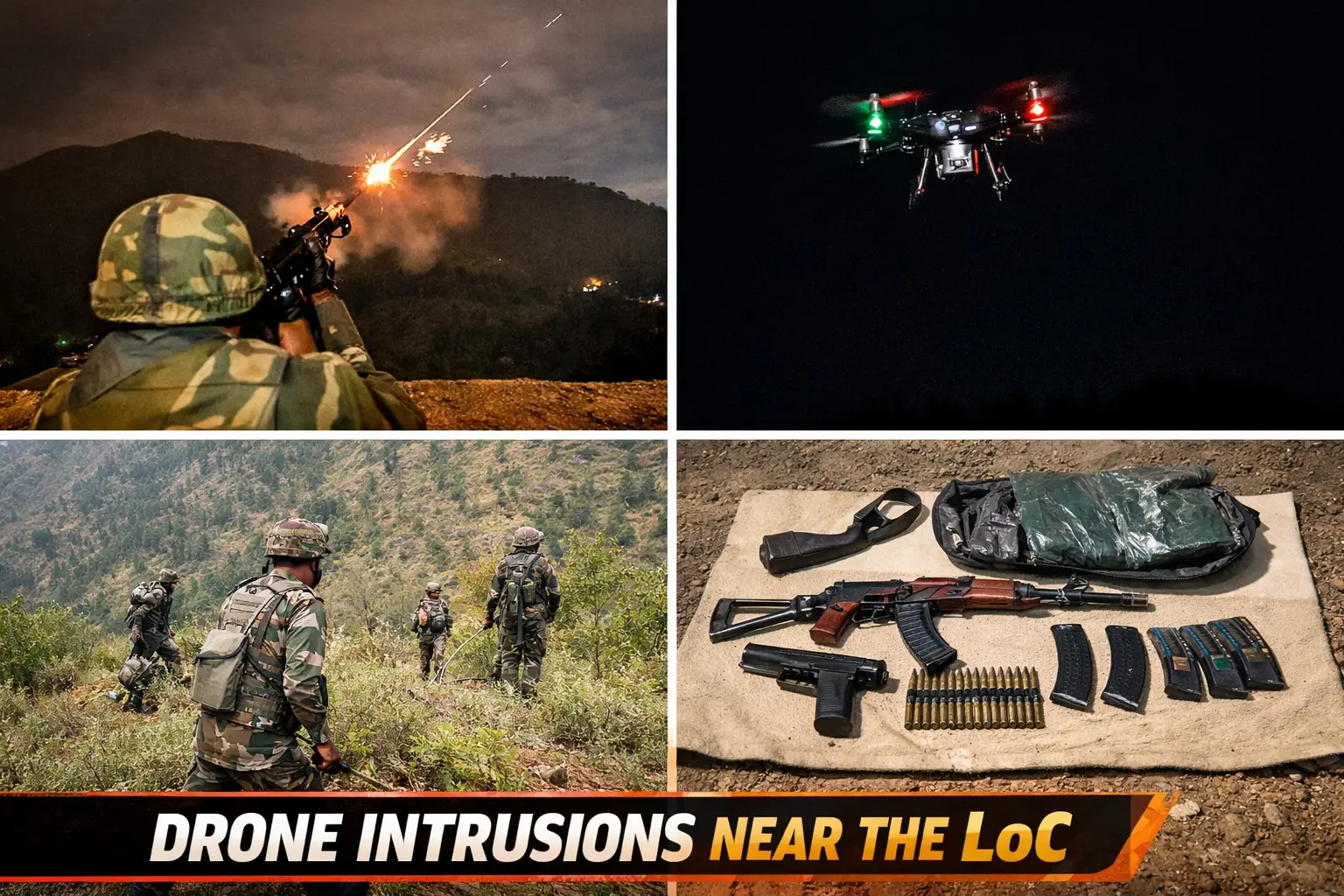
Last night’s sky over Jammu & Kashmir wasn’t just stars and silence. Indian Army posts near the Line of Control (LoC) lit up with tracer rounds as soldiers fired at multiple suspected Pakistani drones spotted over forward areas in Rajouri, Poonch and Samba.
Clips of glowing bullets streaking across the dark sky are now circulating on TV and social media, and everyone’s asking the same thing:
Are we looking at “just” surveillance, or is something bigger being tested?
Let’s break it down.
What exactly happened?
According to reports:
- Multiple drones / “drone-like objects” were seen crossing over from the Pakistan side towards Indian positions along the LoC and International Border (IB) in J&K.
- Sightings were reported from:
- Mankote sector (Poonch district)
- Khabbar area (Rajouri district)
- Ramgarh sector (Samba district)
- In the Nowshera sector of Rajouri, the Indian Army opened fire on a suspected Pakistani drone hovering near the LoC.
- The drones reportedly:
- Entered briefly into Indian airspace
- Hovered for a short duration
- Then turned back towards Pakistan
Security forces have launched search operations in these areas to check if any payload, like weapons, drugs, or communication equipment, was dropped.
So far, this is being treated as a serious security incident, not a random gadget flying around.
Why are drones such a big deal on the border?
In modern conflict, drones are the new Swiss army knife:
- Eyes in the sky – great for surveillance, mapping troop locations, and terrain.
- Silent couriers – used to drop weapons, ammunition, IEDs, drugs, and even counterfeit currency for terror networks.
- Deniability – A country or group can always say, “That’s not ours,” because drones are relatively cheap and easy to modify.
Along the J&K borders, there’s already a track record:
- Arms consignment suspected to be dropped by a drone was recently recovered near the IB in Samba ahead of Republic Day.
- Border forces and the Army have had to adapt to a steady rise in drone-linked smuggling and suspected terror logistics.
So when multiple drones show up across sectors in one evening, it’s not treated as a coincidence. It looks more like probing, testing India’s detection and response.
Why now?
The timing is not random:
- We are close to Republic Day, when security is always on high alert.
- The region has seen heightened cross-border activity in the past, from infiltration attempts to arms drops and ceasefire violations.
Drone intrusions just before a national event are like someone rattling the gate at midnight, not breaking in yet, but definitely checking how strong the lock is.
How is India responding?
The response has a few layers:
Immediate: Fire & search
- Troops responded with machine gun fire against the drones near Nowshera, similar to how they engaged targets during previous operations like Op Sindoor (where drones and high-tech surveillance were widely used).
- Search operations are on in multiple districts to check:
- Did anything get dropped?
- Are there footprints, tyre marks, or other signs of a pickup network?
Tech & counter-drone systems
India isn’t depending only on guns and binoculars anymore:
- Systems like Indrajaal, an AI-driven wide-area anti-drone shield, are being developed to detect and neutralise drones across thousands of square kilometres.
- Indigenous surveillance drones (like DRDO’s Bharat UAV) are used by the Army in high-altitude and border areas for our own monitoring.
Basically: Drones vs drones, plus radars, plus jammers, the full modern package.
What does this mean for the average Indian?
You might be sitting in Mumbai, Kochi, or Pune thinking, “Okay, but how does this affect my life?”
Here’s the real talk:
- Security doctrine is shifting
Borders used to be defended mainly by boots on ground and big guns. Now, low-cost aerial tech is part of everyday threat calculations. That means:- More investment in counter-drone systems
- More coordination between Army, BSF, police, and intelligence agencies
- Terror logistics are evolving
Drones make it easier to:- Send weapons or drugs without physically sending people
- Support sleeper cells or local networks deeper inside the country
- You’ll see more drone-related rules in civilian life
As hostile drone activity increases, expect:- Stricter rules around flying commercial and hobby drones
- More “no-fly” zones in cities, around airports, defence installations, and VIP areas
Is this war territory or just pressure tactics?
Important nuance:
- These intrusions are provocative but still below the clear “act of war” threshold.
- They fit into a pattern of grey-zone tactics, moves that irritate, probe, and test without triggering full-scale conflict.
This is not a punch in the face yet, more like someone circling you, stepping into your space, checking how fast you react and how hard you can hit back.
But make no mistake: if a drone is ever caught dropping heavy weapons or causing direct damage, the response could be far more aggressive and visible.
So, what should we be watching next?
If you’re tracking this story like a pro, keep an eye on:
- Follow-up searches – Did security forces recover any arms, drugs, or communication devices from the suspected drop zones?
- Official statements – Does the government term it “routine probing” or signal something more serious diplomatically?
- Tech announcements – New deployments or trials of counter-drone systems near the LoC and IB.
- Pattern over time – Is this a one-off spike or part of a longer trend of drone intrusions?
The bottom line
- Multiple drone intrusions near the LoC and IB in J&K are not random toys in the sky.
- They’re most likely deliberate attempts to test, survey, or support cross-border networks.
- India is responding with firepower on the ground and upgraded tech in the air, but this also signals how future conflicts will look: cheap drones, smart sensors, AI, and quick, precise retaliation.
For now, the story is under control, not under the carpet. The border stays tense, the soldiers stay awake, and the rest of us get a reminder that modern security isn’t just about tanks and jets anymore, sometimes it’s about a small buzzing dot in the night sky that no one can afford to ignore.

Stay Informed With the Latest & Most Important News
Previous Post
Next Post









Advertisement