
Now Reading: The Year Video Became Infinite: Why AI Generators Are Exploding in 2026
-
01
The Year Video Became Infinite: Why AI Generators Are Exploding in 2026

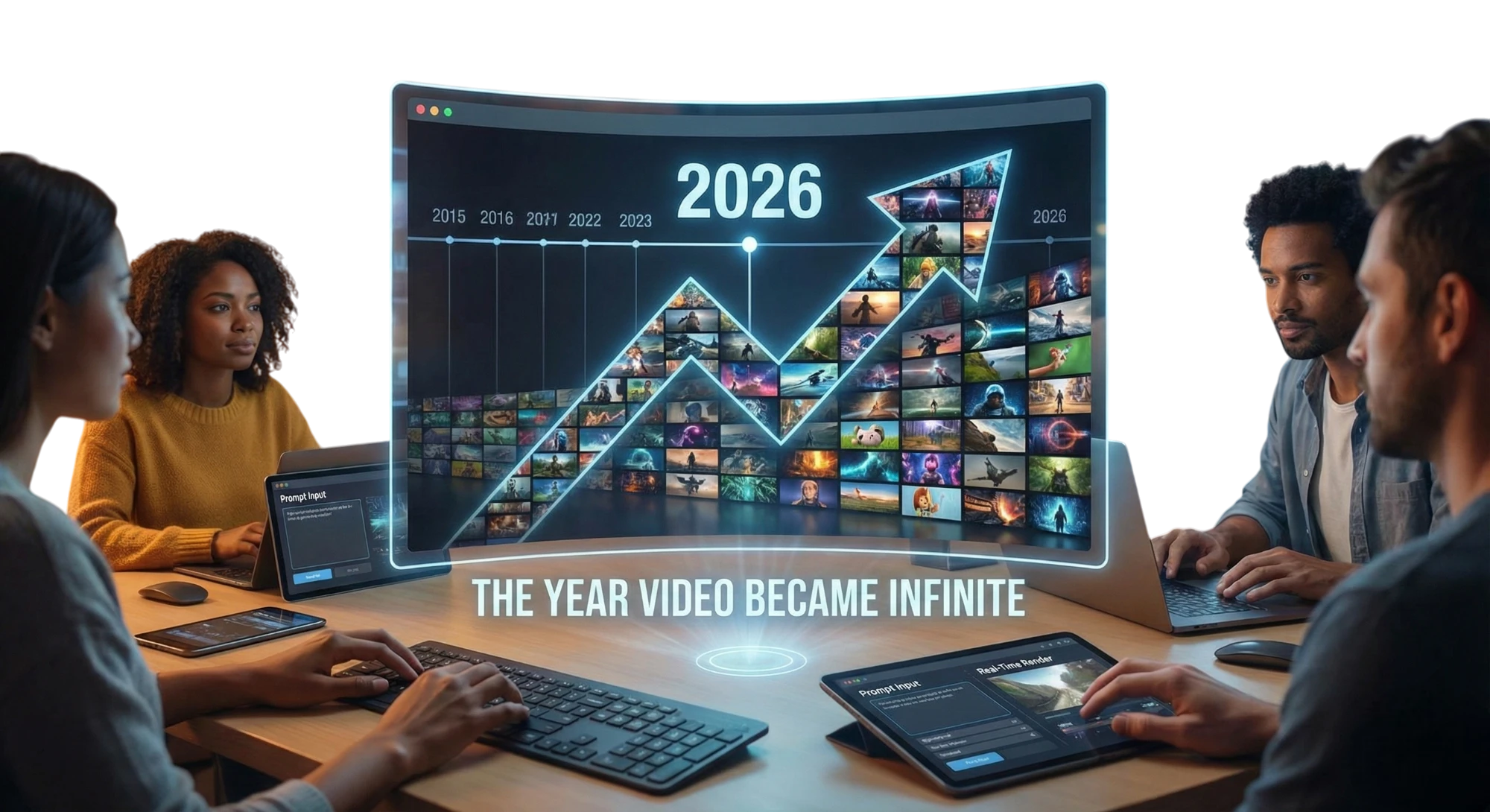
If you told me three years ago—back when we were all laughing at that terrifying AI video of Will Smith eating spaghetti—that I’d be watching an entire short film generated by a single prompt over my morning coffee, I would have called you crazy.
But here we are. It’s January 2026. The spaghetti glitches are gone. The “uncanny valley” has been paved over. And if you’ve opened TikTok, YouTube, or even your Netflix queue this week, you’ve seen it: AI video isn’t just “coming” anymore. It has taken over.
We are currently living through the biggest shift in media production since the invention of the camera. The barrier to entry for high-end cinematography has effectively dropped to zero—provided you have the right vocabulary.
Here is why 2026 is the year AI video generators went from a novelty toy to the engine of the internet.
1. The Death of the “Stock Footage” Look
Remember the early days of 2024? You could always tell. The lighting was a bit too perfect, the physics of water didn’t quite make sense, or a hand would mysteriously sprout a sixth finger.
That changed with the release of the latest generation of models late last year (looking at you, Sora 3.0 and Runway Gen-5). The physics engines inside these models now understand how light refracts through glass, how cloth folds over a moving body, and, crucially, how human micro-expressions work.
We aren’t just generating “clips” anymore; we are generating continuity. The biggest frustration of 2025—character consistency—has been largely solved. You can now take a character generated in Scene A and drop them into Scene B without them morphing into a different person. For indie filmmakers, this was the missing link. You don’t need to reshoot; you just re-prompt.
2. The Rise of the “One-Person Netflix”
The most exciting trend I’m seeing right now isn’t coming from Hollywood (though the recent Disney-OpenAI partnership is definitely shaking things up). It’s coming from teenagers in their bedrooms.
We are seeing the rise of the “One-Person Studio.”
In 2026, a single creator can write a script, generate the actors, score the soundtrack, and render the VFX on a laptop. We have moved past “text-to-video” into “text-to-cinema.”
- Faceless Channels 2.0: YouTube is currently dominated by high-production documentary channels that have zero camera crews. The visuals are indistinguishable from BBC productions, but they are created entirely by solo storytellers using tools like Kling and Veo.
- The End of B-Roll Hunting: Creators used to spend hours searching stock libraries for “sad man looking at rain.” Now, they just type
[cinematic shot, 35mm, melancholic lighting, man looking out rainy window in Tokyo apartment]and get a unique, copyright-cleared shot in seconds.
3. Hyper-Personalization: Ads That Know You
This is where it gets a little Black Mirror, but also fascinating. Marketing in 2026 has shifted from “demographic targeting” to “real-time generation.”
The ads you see on your feed aren’t just selected for you; they are often created for you on the fly. If you’ve been looking at hiking boots, the video ad you see might generate a scene of a hiker navigating the exact trail you were just Googling.
Brands are no longer filming one expensive commercial and hoping it lands. They are generating ten thousand variations, testing them in real-time, and letting the AI optimize the edit while the campaign is still running. It’s ruthless efficiency, but it works.
4. The “Human Premium”
With all this synthetic perfection, a counter-movement was inevitable.
Just as vinyl records surged when Spotify took over, we are seeing a massive premium placed on “Human Verified” content.
In a world where you can generate a sunset in seconds, a shaky, grainy video of a real sunset filmed on a phone has suddenly gained new value. Authenticity is the new luxury.
We’re seeing creators explicitly label their work as “100% Human Made” or “No AI Used.” It’s becoming a badge of honor. Audiences in 2026 are developing a sophisticated palate; they enjoy the AI spectacle for entertainment, but for connection, they still crave the messy, unpolished reality of human experience.
5. The Legal & Ethical Guardrails Are Finally Here
The Wild West days are mostly behind us. The implementation of the C2PA (Coalition for Content Provenance and Authenticity) standards means that almost all reputable AI video tools now embed invisible watermarks.
You might have noticed the “AI Generated” tag is now mandatory on most social platforms. While deepfakes are still a massive issue (and likely always will be), the tools to detect them have improved drastically. The fear that “we won’t know what’s real” is being managed by a “trust but verify” layer of the internet.
What This Means for You
If you are a creator, a marketer, or just someone who loves stories, the message for 2026 is clear: Do not be afraid of the tool.
AI video generators haven’t replaced filmmakers; they’ve just removed the logistical friction of filmmaking. The “idea” is now the only bottleneck.
If you have a story that was previously too expensive, too complex, or too impossible to film—now is the time to make it.